Don Quijote y Sancho Panza
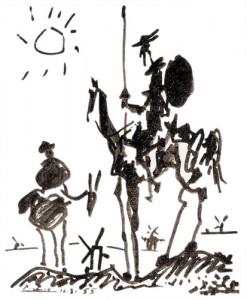 Don Quijote and Sancho Panza. Any Latin person can picture these two characters immediately. Picasso painted them. Young children pretend to be them. The story of Don Quijote mistaking the windmills for menacing giants is ubiquitous in our childhood. It is hard to fathom that these names and images mean nothing to most Anglos. These are the King Arthur and Lancelot of Spanish culture.
Last night I watched Man of La Mancha with the kids. It is a 1972 movie with Peter O’Toole and Sophia Loren based on a popular musical, which produced the well-known “The Impossible Dream” song. The musical itself is based on the most revered piece of Spanish literature, a 16th century novel by poet/playwright Miguel De Cervantes, Spain’s Shakespeare. Cervantes is credited by many with inventing the modern novel. His Don Quijote de La Mancha is the epitome of historical fiction, featuring an old Spanish Lord who goes a little nuts and believes he is a knight that needs to right all the wrongs in the morally ambiguous times of the Middle Ages and Spanish Inquisition.
Don Quijote de La Mancha is required high school reading in every Spanish country, as it is the best known work in Spanish, second only to the Bible. It was actually quite a thrill to be able to bring this perspective to our young boys, albeit a little strange to watch it sung and performed by English-speaking characters.
Watching this movie on the heels of completing our four-month reading of the entire story of King Arthur brought a rich background to Don Quijote’s tale, one that would have been impossible to grasp as a Spanish Lit student growing up in Puerto Rico. I am now extremely familiar with the Medieval knight’s codes of chivalry and conduct, their need for a lady, a quest, and their countless adventures. Little Thomas even commented on how it reminded him of Monty Python’s Holy Grail humor.
Turns out having read Candide by Voltaire also proved helpful, as another literary example of the same perverted and confusing world that was the end of the Middle Ages, with its power hungry lords, warriors, and church figures, and endless forms of cruelty.
The one thing Americans do glean from Don Quijote are a few little used words: quixotism, quixotic, quixotical, quixotically.
- Caught up in the romance of noble deeds and the pursuit of unreachable goals; idealistic without regard to practicality.
- Capricious; impulsive: “At worst his scruples must have been quixotic, not malicious” Louis Auchincloss.
[From English Quixote, a visionary, after Don Quixote, hero of a romance by Miguel de Cervantes.]
Man of La Mancha shed light on many themes — Cervantes, the author, an idealist with a formidable imagination and an uncanny ability to weave words; his endless cast of characters; the makings of a medieval play as a form of entertainment and cultural reflection; and of course, the poetry of the music itself: a lyrical powerhouse that has endured almost 40 years.
I printed “The Impossible Dream” lyrics and we spent some time reading and enjoying it today. Thomas and Gabo were touring our vegetable garden singing, “I am I, Don Quijote, the Lord of La Mancha…”
The Impossible Dream
music by Mitch Leigh & lyrics by Joe Darion
To dream the impossible dream
To fight the unbeatable foe
To bear with unbearable sorrow
To run where the brave dare not go
To right the unrightable wrong
To love pure and chaste from afar
To try when your arms are too weary
To reach the unreachable star
This is my quest
To follow that star
No matter how hopeless
No matter how far
To fight for the right
Without question or pause
To be willing to march into Hell
For a heavenly cause
And I know if I’ll only be true
To this glorious quest
That my heart will lie peaceful and calm
When I’m laid to my rest
And the world will be better for this
That one man, scorned and covered with scars
Still strove with his last ounce of courage
To reach the unreachable star